
IN-DEPTH ENGLISH EDITING

Turning an English text into a publication-ready manuscript

In-depth English editing goes far beyond grammatical correction. It addresses clarity of expression, fluency of style, coherence of argument, terminological precision and conformity with the conventions of English-language academic publishing.

Expressum works with researchers, authors and institutions on scholarly texts written directly in English or translated from another language.
LEVELS OF INTERVENTION

Editing at several levels

Depending on the nature of the text and its stage of completion, editing may address both language and the structure of the argument. It may also reveal errors, inconsistencies or mistranslations already present in the text or introduced during translation. These are flagged for the author in comments, which may also include scholarly observations when they are genuinely relevant.

  • Language correction
    Grammar, syntax, punctuation and idiomatic usage.
  • Clarity and fluency
    Reworking awkward, ambiguous or unnatural passages while preserving the author’s voice.
  • Structure of the argument
    Improving the progression of ideas, transitions and overall readability of the reasoning.
  • Terminological consistency
    Checking and harmonising specialist vocabulary throughout the text.
  • Checks and comments
    Flagging errors, inconsistencies or mistranslations present in the text or introduced by human or AI-assisted translation, with explanatory comments where needed.
  • Academic conventions
    Adapting the text to the conventions of English-language academic publishing, with substantive or scholarly comments where they genuinely add value.

TEXTS WE EDIT

Texts at different stages of completion

Editing may be carried out on a text written directly in English, on a translation produced by a professional translator, or on a first version generated or assisted by machine translation or AI. The level of intervention is adapted to the quality of the text, its intended purpose and the degree of revision required before publication.

  1. Research articles and book chapters
  2. Books and collective volumes
  3. Exhibition catalogues and museum texts
  4. Research projects and reports
  5. Texts written directly in English
  6. Human or AI-assisted translations

A RIGOROUS EDITING METHOD

From initial assessment to a submission-ready text

Each text is first assessed as a whole in order to determine the level of editing required. The process combines language correction, stylistic improvement, consistency checks and comments drawing the author’s attention to points that require clarification or decision.

01 — Assess

Assess the text

The document is read as a whole to identify issues of language, style, structure, terminology and any inconsistencies that may affect clarity or accuracy.

02 — Edit

Edit in depth

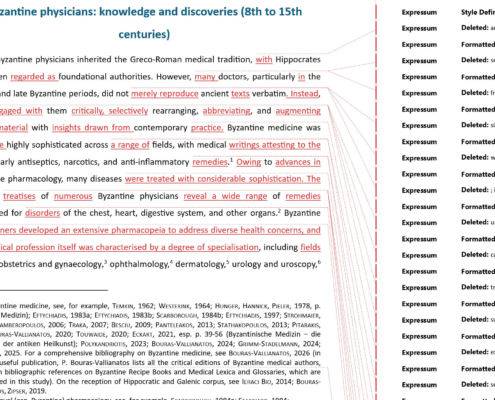
Corrections and reformulations are made directly in the text using Track Changes, so that the author can see precisely what has been altered.

03 — Flagging

Flag and comment

Comments are added where the text contains ambiguity, an error, a mistranslation or a point requiring the author’s decision. Scholarly observations may also be included when they are genuinely relevant.

04 — Harmonise

Harmonise and finalise

A final review ensures fluency, consistency, terminological precision and conformity with the conventions of English-language academic publishing.

SELECTED WORK

Specialist texts prepared for publication

EDITING EXAMPLES

From targeted correction to in-depth restructuring

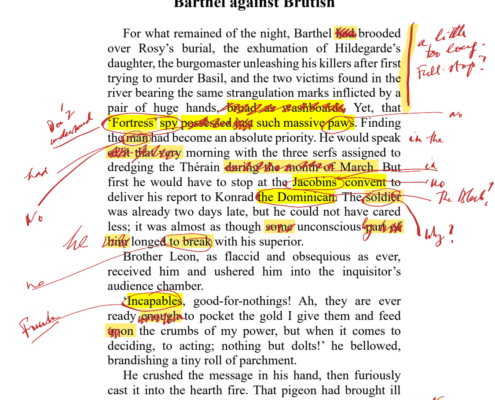
In-depth editing can go far beyond correcting grammar. Depending on the text and its purpose, it may involve syntax, terminology, argument structure, internal consistency, register and overall readability.

Editorial and stylistic editing

Example of editorial revision with handwritten corrections

Line-by-line work on style, phrasing, lexical precision and the overall flow of the text.

In-depth scholarly editing

Example of in-depth scholarly editing with tracked changes

Rewriting, restructuring and clarifying a specialised academic text, with detailed tracking of changes.

House of European History

In-depth editing of exhibition catalogues, museum content and interpretive texts intended for an international audience.

Royal Fortresses of Carcassonne

Translation and editing of a 366-page international volume, together with documents relating to the UNESCO nomination.

Scholarly publications

Editing of articles, book chapters and contributions to collective volumes, addressing language, style and terminological consistency, with comments to the author where required.

Editing does not stop at language. When an error, inconsistency or mistranslation is identified in a text, it is flagged for the author. Scholarly observations may also be added when they are directly relevant.

Do you have a text that requires extensive revision?

Whether it’s an article, chapter, book, catalog, or text—whether translated by a human or with AI assistance—send us your document and let us know its intended use. We’ll recommend the appropriate level of editing.